
Scientists from China created a robotic capture inspired by plant pods. The idea is based on bistabhyal mechanisms – devices that can remain in two stable states without energy consumption. The simplest example is hair clip. Previously, bistabhyl captures either demanded too much power to work, or were too weak to hold heavy objects.
The new capture solves this problem: at the first capture, the object is held with minimal force, but after fixing the mechanism automatically enhances its clutch. For inspiration, the scientists turned to the pods in a shortage: while the seeds are immature, the pod is difficult to open, but as soon as the seeds ripen, any light pressure, for example, a drop of rain, forces it to “shoot” seeds. Here A good demonstration of the process.
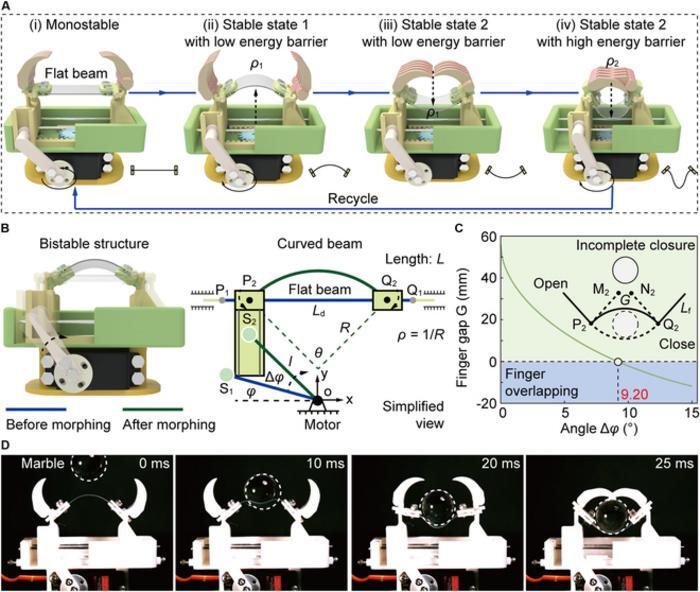
The capture consists of two “fingers” connected to an elastic beam and rotating shafts. In the initial state, the beam is flat. When capturing the shaft, bend the beam, reducing energy for operation. When the object is pressed onto the beam, it bends down, clasping the item. Next, the shafts bend the beam even more, enhancing the retention. It seems that they clearly described.