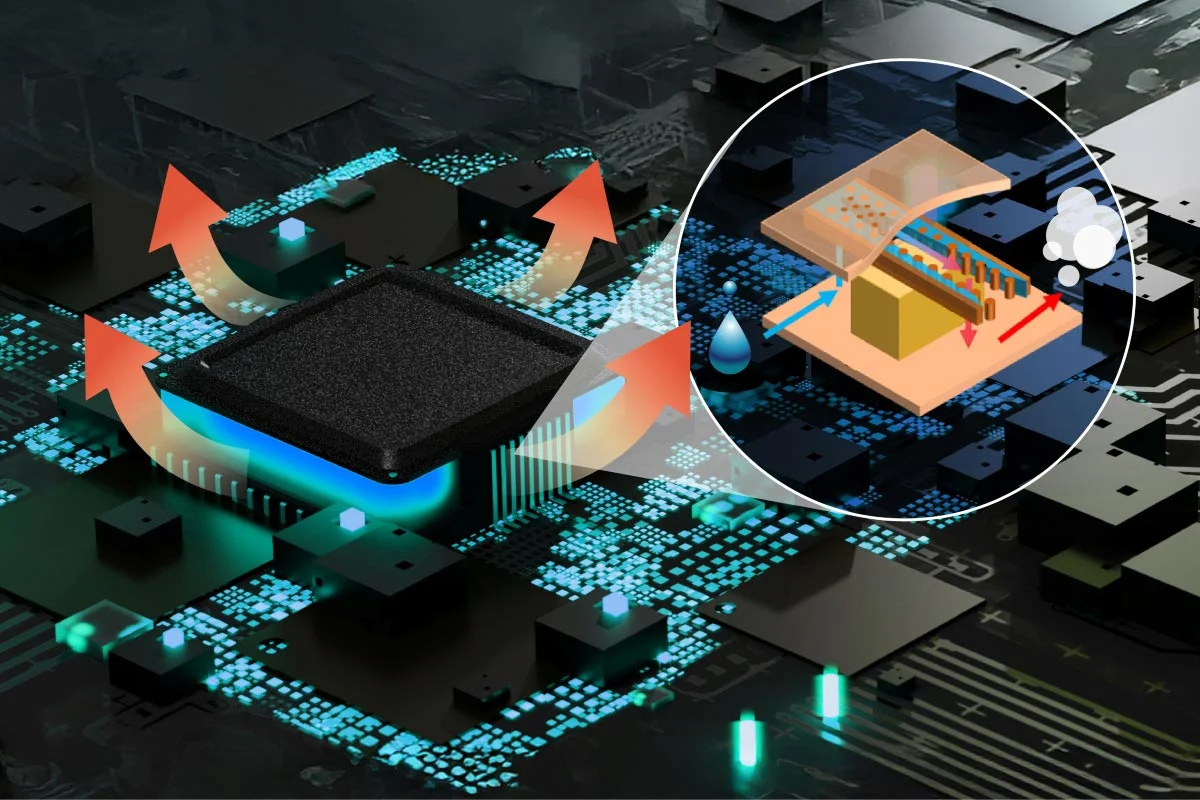
Engineers from the University of Tokyo have introduced a groundbreaking 3D water-cooling system for chips.
Thanks to the unique geometry of microchannels and capillary structures, it uses the phase transition of water—evaporation—for heat removal, rather than merely heating it. This enables heat dissipation 7 times more effectively compared to traditional methods, which are limited by so-called “sensible heat.”
The system is built on three-dimensional microchannels with a distribution layer that manages the flow of cooling liquid. Scientists have developed several geometric variations and tested them under different conditions.
The new method demonstrates a record-breaking coefficient of performance (COP)—up to 105, significantly higher than conventional solutions.
The technology could become critical for cooling powerful future processors, especially as chip miniaturization and performance levels rapidly increase. The development also promises to enhance the energy efficiency of electronics and contribute to achieving carbon neutrality.