
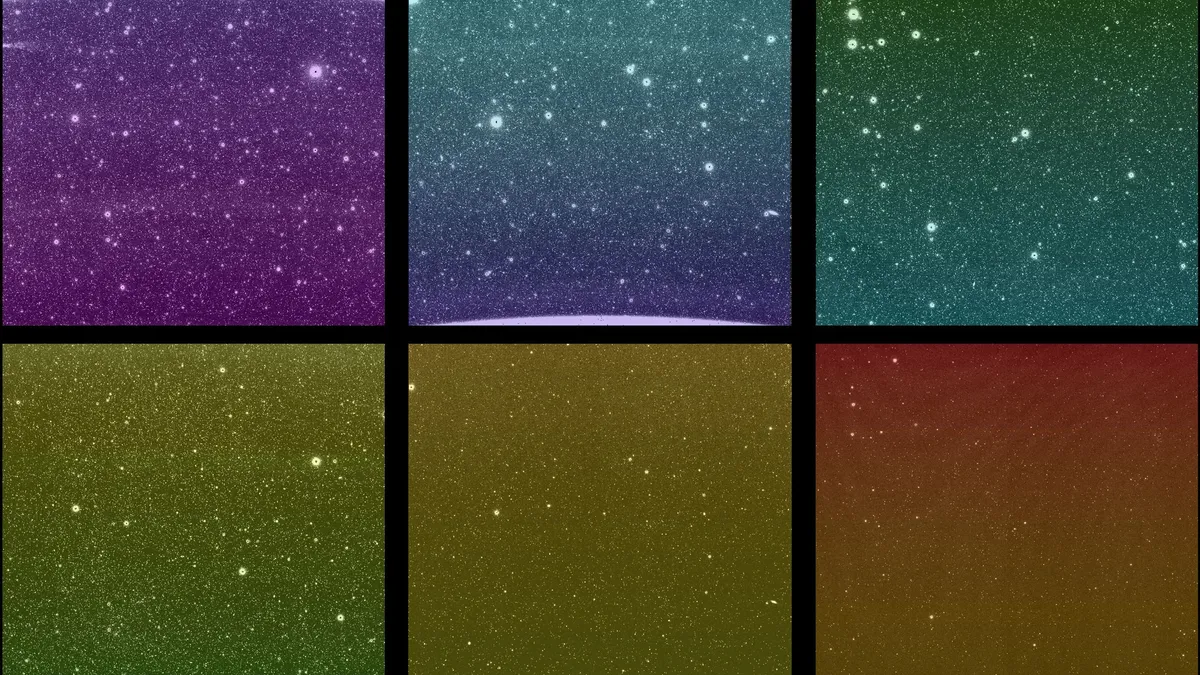
NASA’s new infrared telescope, called SPHEREx, has captured its first cosmic images, confirming that all systems are functioning perfectly. Launched on March 11, 2025, from California’s Vandenberg Base aboard a SpaceX Falcon 9 rocket, SPHEREx—Spectro-Photometer for the History of the Universe, Epoch of Reionization, and Ices Explorer—is already exciting scientists. “The team nailed it,” said the project’s principal investigator, Jamie Bock, from the California Institute of Technology and NASA’s Jet Propulsion Laboratory.
SPHEREx stands out from other telescopes, like James Webb, due to its wide-angle survey capabilities. While Webb focuses on detailed views of distant stars, SPHEREx maps the entire sky in infrared—a type of light invisible to the eye but capable of penetrating cosmic dust. The first images reveal about 100,000 objects per frame, including faint galaxies. The telescope uses six detectors, each capturing 17 unique wavelengths, resulting in a total of 102 bands for analysis.
Currently, the detectors are being cooled to ultra-low temperatures to prevent heat from interfering with measurements. Ahead lies a two-year mission for SPHEREx: it aims to study over 450 million galaxies and 100 million stars in the Milky Way.