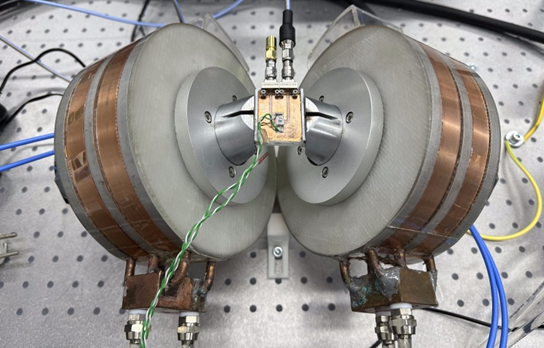
Russian scientists from MIPT have developed a very small spintron detector who can not only catch microwaves, but also determine the direction of their polarization. The detector is made of a thin film of lutecia grenade and platinum, its thickness is a little more than 100 nanometers.
When microwaves fall on a grenade, magnetic vibrations occur in it, which create a spin current. This current in a platinum layer turns into an electrical signal, which depends on the polarization of the waves. Thanks to this, the device can accurately “see” how the microwaves are directed.
Scientists have made a universal detector: using a magnetic field, you can change the frequency of work, use it as a filter or converter. This opens up opportunities to create on its basis miniature communication modules for satellites, medical sensors for monitoring processes in the body, radars for drones and elements for quantum electronics.
Now researchers continue to study how the detector works with different types of polarization in order to expand its application.