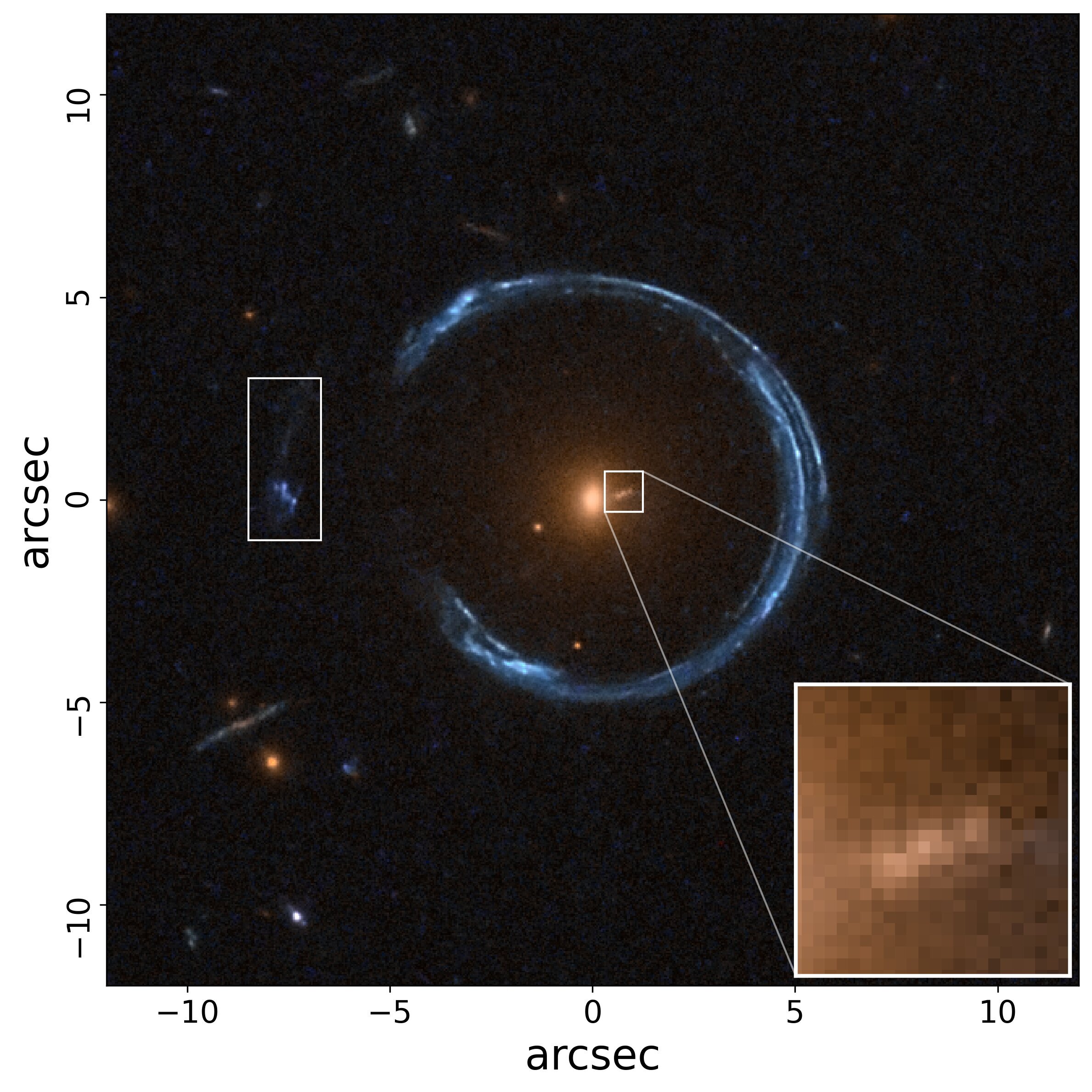
In the scientific journal Monthly Notices of the Royal Astronomical Society, an article on the discovery of scientists from Portsmut University and the Federal University of Ri-Grand-Du-Sul in Brazil, possibly the largest black hole, was found. This black hole was found in the center of the Space Snow galaxy, which is located 5 billion light years from the ground.
The mass of the black hole is 36 billion times larger than the mass of the sun, which is 10,000 times higher than the mass of the black hole in the center of the Milky Way. The galaxy, where they found a new space object, is called this because of Einstein’s ring-the effect of gravitational lenses-the curvature of light emanating from an even more remote galaxy. This indicates its belonging to galaxies-fasteners, formed as a result of the merger of several smaller galaxies. “Cosmic horseshoe” is the only bright galaxy in its group, which indicates the absorption of other galaxies.
To measure the mass of the black hole, gravitational lenses and star kinematics were used. Usually a reliable method is to track the movement of stars, but for distant galaxies it is less effective. The unification of these methods made it possible to measure the mass of the black hole at a greater distance.