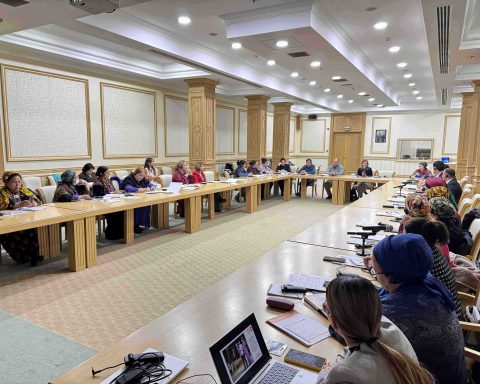
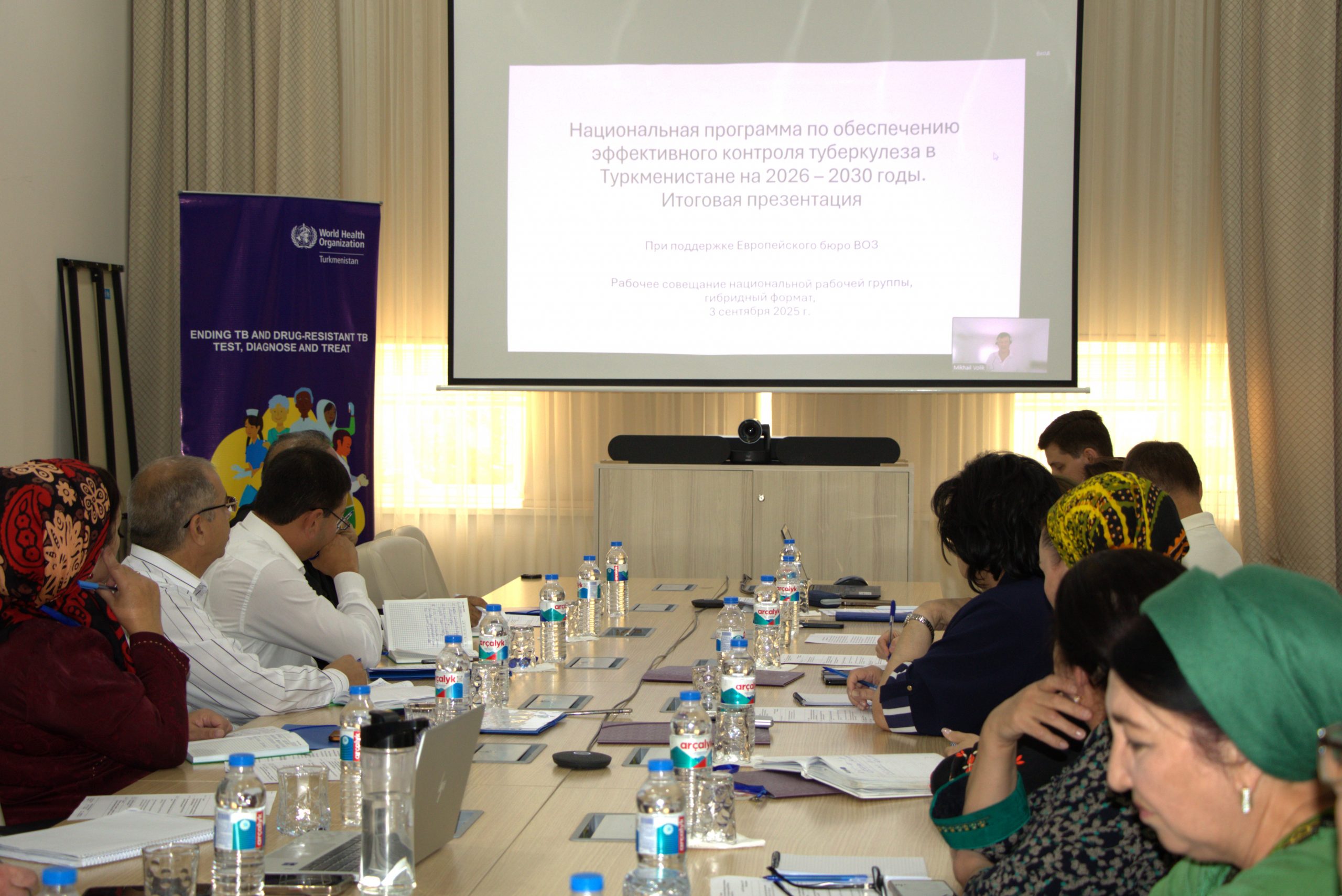
A meeting of the national working group on the development of the National Strategic Plan for Tuberculosis Control in Turkmenistan for the period 2026–2030 was held today by WHO Country office at UN building in Ashgabat.
The meeting took place in videoconference mode and was opened by WHO Representative in Turkmenistan, Dr. Egor Zaitsev. It was led by Dr. Askar Yedilbayev, Regional TB Adviser from WHO/Europe together with Dr. Mikhail Volik, WHO expert. In his remarks, Dr. Zaitsev emphasized that updating national guidelines on tuberculosis control and treatment, conducting operational research, and implementing other key activities coordinated by WHO/Europe with the support of UNDP and the Global Fund have all contributed to significant progress in the implementation of Turkmenistan’s National Program on Tuberculosis Control for 2021–2025.
The meeting provided an opportunity to present and discuss final draft of the new National Strategic Plan (NSP), which will guide the country’s efforts to combat tuberculosis (TB) over the next five years. The National Strategic Plan is fully aligned with the WHO regional initiative TB free Central Asia and based on key priorities of TB action plan for the WHO European Region 2023–2030. The plan builds on the achievements of the previous NSP 2021–2025 and incorporates updated global and regional strategies for TB prevention, diagnosis, and treatment. Discussions centered on two priorities: presentation of the finalized National Strategic Plan for Tuberculosis Control 2026–2030, the next steps for its adoption and implementation, as well as a review of the progress achieved with the TB-RRIS electronic program in Turkmenistan and consideration of strategies for its further expansion across the country to strengthen surveillance, monitoring, and reporting systems.
The meeting brought together members of the national working group from the Ministry of Health and Medical Industry of Turkmenistan, along with representatives from the National Red Crescent Society and the Medical Service of the Ministry of Internal Affairs of Turkmenistan.
Speaking at the meeting, WHO experts emphasized the value of aligning Turkmenistan’s national strategies with international best practices and evidence-based approaches, while tailoring interventions to the specific needs of the country. They also noted that the TB-RRIS system represents a significant step forward in digital health solutions, enabling more efficient case management and real-time data collection to inform policy and practice.
This collaborative effort marks a significant milestone in Turkmenistan’s commitment to public health and its determination to strengthen national TB control programs. The new National Strategic Plan for 2026–2030 will serve as a roadmap for accelerating progress, reducing the burden of tuberculosis, and ultimately improving the health and well-being of the population.